Showing posts with label Bruce Sterling. Show all posts

3/26/2012

Mali Tuareg Rebelion and Islands in the Net by Bruce Sterling

This post is also available in Macedonian | Овој пост е достапен и на македонски
- преку Блогерај: Бунтот на Туарезите во Мали 


Bruce Sterlings's "Islands in the Net" (1988) remains a time-resistant science-fiction book worth re-reading. Published over a quarter of century ago, it remains extremely current, in its anticipation of the influence of the Internet on the global scale. Part of the action takes place in Mali and is about the guerrilla fight of the Tuaregs/Kel Tamasheq, which recently gained prominence worldwide.


Tuareg fighter and Mali soldier.

Some time ago I noticed new Mali Tuareg-related article on Global Voices, which expanded into a continuous story after the military coup which attracted the attention of mainstream media. I decided to translate into Macedonian one of the articles, but ended up translating the sequel too, and supplemented that by translating part of the Wikipedia article on these people (as I presume most people at first glance would assume that Tuareg is just a vehicle brand).

Here are links to the original articles and their Macedonian counterparts.

9/26/2010

Bruce Sterling @ University & Cyberspace

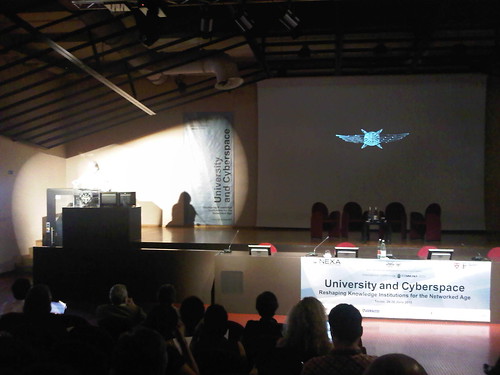
Bruce Sterling gave a great speech about the term and the concepts of cyberspace at the COMMUNIA 2010 Conference: University & Cyberspace that took place in Turin, Italy, 30 June 2010.

The speech is available online in video format via the conference website. Click on the link "(00h 28m 00s)" on the webpage bellow the video to set it to the right minute.

Not in the video: during the speech Bruce mentions the U.S. Air Force Cyberspace Operator Badge, which you can see on the photo bellow.

Bruce Sterling and USAF Cyberspace Operator Badge


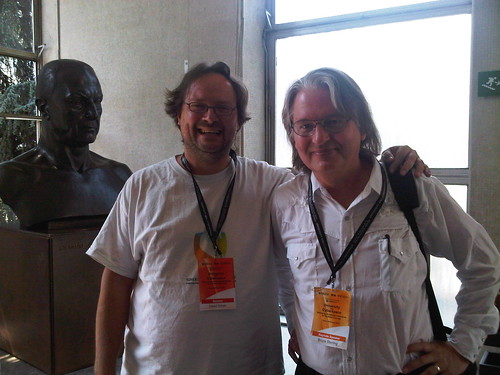
After Sterling, David Orban from Humanity+ & Singularity University also gave an inspirational speech, which is also available online on the page above. I took this joyful photo of the two of them during the break a little later.

David Orban & Bruce Sterling

Both photos were taken on the grounds of the Politechnico in Turin. In the background you can see the bust of Giovanni Agnelli, founder of FIAT, obviously a revered figure in this Italian motor-town, like I assume Henry Ford would be in Detroit.

7/13/2010

More "authentic" Jesus in sci-fi

From time to time Christians world over act surprised about the notion that the usual image of tall, slender, long-haired and pretty pale Jesus does not confirm with the fact that he was a Jew from Palestine and shared the attributes of that ethnic group two thousand years ago. However, two examples show that science fiction authors were quite mindful of the historical and anthropological context.

Through links provided by Vladimir Simovski, it is quite obvious that presentations of Jesus, like those of various other shared iconic characters tend to reflect the influences of time and cultures that use them. On the other hand, forensic anthropological research conducted in 2000 reconstructed "The real face of Jesus" (PDF), based on data from the Scriptures which present him as "an average I century Joe," no different from his contemporaries: somewhat short, muscular, dark-skinned, curly-haired and bearded Semites.

The character of Jesus appears in the novelette Riverworld (1966) by Philip José Farmer. Widelly acclaimed as one of the best pieces of the series with the same name, based on the premise that alien intelligence resurrects all humans on a single planet, it juxtaposes the pacifist Joshua ben Joseph with the short, dark, green-eyed cowboy actor Tom Mix.

John Kessel's Corrupting Dr. Nice (1997) is a time-travel novel based on the premises of colonial exploitation of parallel worlds developed by Bruce Sterling and Lewis Shiner in their short story Mozart in Mirrorshades, first published in Mirrorshades: The Cyberpunk Anthology (1986).

The plot partly takes place in a 40 A.D. Palestine, and characters include Yeshu and one of his apostles, Simon the Zealot. Kessel's descriptions of the Roman world occupied by American time travelers, and the attempts of the locals to deal with it through adaptation or resistance (including terrorism) are insightful and entertaining, because the characters are modeled according to the latest scientific notions of the life at the time.